Showing posts with label history. Show all posts

Saturday, 18 July 2015

A Grave Concern


I was always interested in history.  As a kid in the sixties, I remember at about the age of seven asking for a ‘really good history book’ for Christmas, and my parents did me proud.  I got the complete R J Unstead’s ‘History Of Britain’, which was so good it scarcely left my side for the next five years.  I still have it now though its so basic its scarcely any use except as a picture source..

For me, an interest in art and history go hand in hand.  Every work of art has its own history, and throws up questions about why it was painted, what reasons the artist had for painting it.  Then there are the questions about the times they lived in.  What were the conditions that surrounded the artist as they began work? When they took up that paintbrush or chisel, what exactly was outside the door?

The detail can be extreme; what was the world like that was driving this work of art?  What kind of clothing was the artist wearing, what was the street outside like, how did they make their brushes and paints?  How did Michelangelo actually sculpt the David?  

Looking At History.  This edition about 1966.
And that brings me to Roman Military tombstones.  No, they’re not as good as Michelangelo’s stuff by any stretch of the imagination but in their own modest way just as interesting.  I was brought a book on this subject a while back, and I wasn’t too sure why at first.  The subject seemed very dry and the rather crude little images a little charm less.  But after throwing it aside for a while I went back to it, and perseverance was rewarded.

It has photographs of the tombstones, with translations of the inscriptions and a little about the situation of the deceased soldier, what legion he served with, what rank he had, and a potted history of where the stone was discovered and what period it belonged to.  And I began to look at the sculpture on these stones critically.  It has to be said mostly they weren’t very good.  Except one.

Step forward Marcus Favonius Facilis.  The tombstone of this Roman centurion is the best of the bunch.  Found in England at Colchester in 1868 it’s a fine depiction of a centurion of the mid first century AD.  It’s so good that it has subsequently been used by almost every Roman legionary re-enactment society as the basis for their own reconstructions of a centurion's costume.  And it’s because of the clarity of the sculpture that it’s been so useful on this account.

The grave stele of Marcus Favonius Facilis.  The author.
The sculptor must have had knowledge of classical methods, and either had come from the Mediterranean, or had know someone who had been trained in that culture, this can be inferred from looking at the work and comparing it with the crudity of other stones.  And when we think clearly about that time, for an artist to gain real skill and knowledge would have been incredibly difficult, for as I have tried to show in last weeks blog, you need to see a lot of other work to learn anything useful.

For one, the Facilis sculptor understood about ‘foreshortening’ an important concept for any artist if they wish to represent anything realistically.  He knows that if you depict the hand on the hilt of the sword, then the elbow of that arm will be thrust backwards, and will not be visible.  Another sculptor depicting a standard bearer, named Gnaeus Musius, can only show this by having the entire right arm visible, awkwardly holding the standard out at the soldier’s side.  

Again, the Facilis sculptor understands that when you stand facing someone and look down at the ground, you see the floor seemingly sloping away behind the person.  This gives his work a sense of three dimensions.  The sculptor of the Musius stone doesn’t understand this or thinks it unimportant, and depicts the ground as a single line under the soldier’s feet.
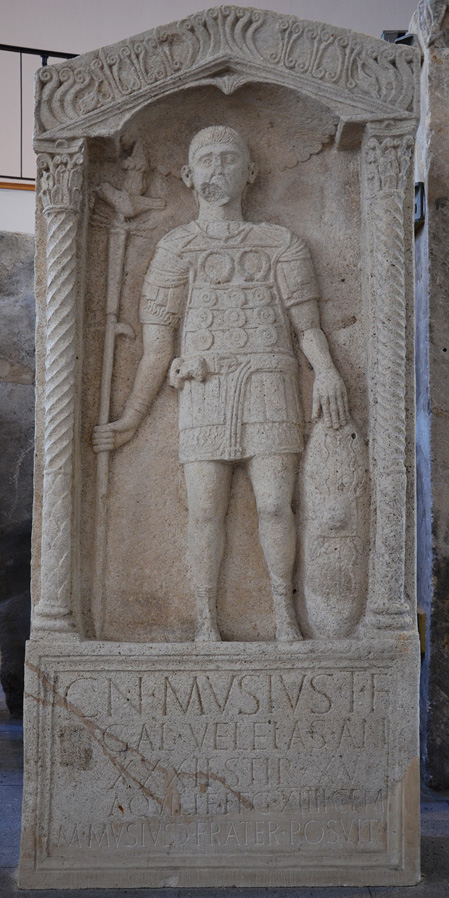
The Gnaeus Musius stele.  Wikipedia commons.
The Facilis sculptor understood the classical form, that a figure can be made to display grace and ease by the simple expedient of giving the torso a slight curve (what the artist Hogarth called the ‘line of beauty and grace’).   The weight of the subject held on the right leg pushes out the opposite hip, which in turn causes the torso to curve over to the right.  The sculptor finishes by either positioning the head centrally or by emphasising the curve still further by depicting it on a slight tilt.

The Musius sculptor is unable to depict the standard bearer in a realistic and convincing posture, he stands stiffly and completely upright as if he really were made of stone, the limbs clumsily realised and the only thing the sculptor is interested in doing is depicting the soldiers armour and decorations in close detail.

There is of course a school of thought that states that the Facilis stele is copied from a statue of the emperor Claudius.  If you study the slightly eroded head of Facilis' figure you see easily that it has quite large sticky out ears.  This was a feature of all portrait busts of Claudius because - well, he had sticky out ears.  So its possible that the sculptor knew a statue of the emperor (now lost) that he used as a model.

The Facilis grave stele is not one of the great sculptures of the world  but it probably is one of the finest military sculptures from the ancient Roman world and it’s odd that its sculptor will only ever be known by this one modest sized work.  I can only admire this man, possibly a soldier, or a freelance artisan who followed the legion, for his ability to gain such knowledge in such difficult circumstances and to use it to honour brave men.  

My Zazzle page.

My website.
 

Saturday, 27 June 2015

Flight ready


I swore the arms would be done this week, and they are, just about.  All flight systems are on line and she's taxiing on to the runway - well, hopping would probably be a better description.  Hopping because she has legs and feet, as well as arms.  And as you can see from the picture at the top of the page, she has eyes as well.

As usual I began the arms on a separate layer, which was just as well as I've had to cut them up, and rotate them, and bits of them, and move them slightly back and forth over the shoulder region trying to decide what looked right.  And rub out parts of them and redraw and repaint gaps, and cut areas and generally curse and swear.  Was it worth it?  Hmmm, that's debatable.

As I said last week, I decided to have her holding a box instead of a scroll, because I thought that a scroll of the type I envisaged would be awkward and would obscure parts of the arms and chest of the bird.  And you have to be able to see that she's a bird with arms.  Both arms would also have to be pretty extended so I could show that she was unrolling a large scroll.  My sketches weren't promising.

Arms above the basic lines.  Note the gap at the right elbow where I cut it and rotated the forearm.
Above you can see the underlying lines with the arms placed over them.  They don't look right of course, and I've had to pay attention to the left arm, shortening it at the elbow and darkening it for shadow.  But the arms aren't to my liking.  I mess about with the shape of them, redrawing and colouring but I don't really improve them.  They look like a dolls arms, and even though this is an arch fantasy subject it should still look as real as that allows.

Seeing the arms with the rest of the colour layers.  Still no hands.
The box is now in place as well, and its position has migrated around the image by millimetres while I tried to finalise the arms placement.  I've also darkened the feathers just under the arms.  Then began to apply myself to the tricky problem of hands.  I didn't want to spend forever on the web looking for references, as that task can be endless.  You always think that if you look a bit harder you'll find the perfect image, and end up with masses, only to find when trying to use them that they don't really match with what you intended anyway.  But that means trying to 'busk' your way through it.

First hand in, and look at that box - it's slipped down the layer tree so its now under the hair!  I'll have to drag it up again.
Well, the first hand is in, and I'm not overwhelmed by the result, but soldier on anyway.  I manage to make a slightly better hand for the other arm that covers the box, but neither is brilliant.

The finished arms.  That box is a bit plain, it could do with some hieroglyphics or something.
And the legs, which I haven't really shown much of, are finished with scales toes and claws, and it's about this stage that I begin (in fact quite a while ago) to see how funny the thing is.  And that's the genius of those Egyptian painters that they could with a brush and some papyrus quickly and deftly depict this strange being and make it cool and attractive but not funny. 


The finished Ba bird - with added shadow.  Hah ha - sparrowlegs!
  And that's a lesson about approach and style more than anything else; those ancient artists needed images for a single well - defined purpose, to depict a mystic being in the papyruses of the Book of the Dead.  They needed to be quick, clean and easily identifiable.  They had the advantage of having to conform to a particular style, the flat side - on look of the Egyptians, and the images were small, so much so in fact that it's often difficult to see if it's male or female.  Simple, quick, clean.

So there it is.  The trouble with too many Ba birds is that the feathers get up your nose.  Something else for next week I think. 

My website

My Zazzle Page