Showing posts with label "Roman history". Show all posts

Saturday, 1 August 2015

Bits and pieces.


In keeping with the Roman tombstone blog of a couple of weeks ago I'd like to share some work I did a while back concerning a reconstruction of a Roman auxiliary cavalry helmet.  It wasn't done for anything in particular, except that I find such things interesting and like to study them.

In the UK we have a rich historical past and that means plenty of archaeology that needs intricate study in the labs of museums up and down the country, and plenty more still in the ground just waiting to be discovered.  Recently a couple of Roman cavalry helmets have come to light in Britain and I have concentrated on a helmet found in a place called Hallaton in Leicestershire.

A cavalry sports helmet found at Ribchester in Lancashire in 1796.  It would originally have been silvered.  Wikipedia commons.
It was found in 2000 through the efforts of Ken Wallace, a member of the Hallaton field walking group, and the pieces were dug out of the ground still in blocks of earth and spent the next nine years at the British Museum where they were conserved.  The helmet is now on permanent display at the Harborough museum in Market Harborough.

The Hallaton helmet in Harborough museum.  Wikipedia commons

It's of a type called a 'cavalry sports helmet' quite a number of which have been discovered around the Roman world, and would have been used in ceremonial events and in certain kinds of military sports displays.  Probably manufactured in the early 1st century AD it is made of sheets of iron, and would have originally been given a silvered surface, and  been covered with extensive embossed decoration.  Some of this detail has survived, but a lot was badly damaged so part of the game here is to closely scrutinise photographs taken when the helmet was still covered in dirt and see if something can be made of them.

Hallaton helmet cheek guard showing detail of mounted officer with a winged victory.  Wikipedia commons/the author
One of the cheek guards, the left one, was in a reasonable state of preservation and a figure of a general or possibly an emperor can be seen in the typical formulaic Roman manner, riding a horse over the prone body of a barbarian.  This was fairly easy to visualise as most of it was still there, but the front of the crown of the helmet was a sad ruin.  Something of a female head and shoulders portrait can be made out just above the face of the wearer, but most of the top of the head and face of this portrait is missing.

The female portrait at the front of the helmet.  Probably a Roman goddess or local deity.  Wikipedia commons.

As this is very badly eroded only the general sense of the original can be gleaned from study of photographs. So a certain amount of speculation has to be indulged in, and a certain amount of  - yes invention.  The portrait is probably of a Roman goddess possibly Victory, or a local deity.  We all know more or less what a Roman/Greek goddess looks like where statues are concerned.  I'm sure the ancient Romans/Greeks could tell the difference pretty easily, and professors of Roman/Greek history can properly lecture on the ways and means of telling them apart, but to most of us they are fairly similar in look.

And of course all we have to work with here is a head and shoulders. On very close examination you can just make out that she has some plaits of hair hanging at each side of the head, and is wearing some kind of tunic, the creases of which are still just visible.  On either side of the portrait are two lions with prey, in the above image you can just make out the head of a ram on the left of the picture.  These things are heavily eroded and again much imagination was needed to realise these figures, but my own scrutiny of the photographs lead me to believe that the lion is lying down and not on it's haunches as I've seen in other reconstructions.  However they are the experts and have actual access to the real helmet so I'm happy to concede that I am probably wrong. 


So here is my two penn'uth, and it's about as close as I can get without actually seeing the real helmet.  Why did I bother?  As an exercise in drawing and understanding, all part of an artist/illustrators work. 

My website

My Zazzle page

Saturday, 18 July 2015

A Grave Concern


I was always interested in history.  As a kid in the sixties, I remember at about the age of seven asking for a ‘really good history book’ for Christmas, and my parents did me proud.  I got the complete R J Unstead’s ‘History Of Britain’, which was so good it scarcely left my side for the next five years.  I still have it now though its so basic its scarcely any use except as a picture source..

For me, an interest in art and history go hand in hand.  Every work of art has its own history, and throws up questions about why it was painted, what reasons the artist had for painting it.  Then there are the questions about the times they lived in.  What were the conditions that surrounded the artist as they began work? When they took up that paintbrush or chisel, what exactly was outside the door?

The detail can be extreme; what was the world like that was driving this work of art?  What kind of clothing was the artist wearing, what was the street outside like, how did they make their brushes and paints?  How did Michelangelo actually sculpt the David?  

Looking At History.  This edition about 1966.
And that brings me to Roman Military tombstones.  No, they’re not as good as Michelangelo’s stuff by any stretch of the imagination but in their own modest way just as interesting.  I was brought a book on this subject a while back, and I wasn’t too sure why at first.  The subject seemed very dry and the rather crude little images a little charm less.  But after throwing it aside for a while I went back to it, and perseverance was rewarded.

It has photographs of the tombstones, with translations of the inscriptions and a little about the situation of the deceased soldier, what legion he served with, what rank he had, and a potted history of where the stone was discovered and what period it belonged to.  And I began to look at the sculpture on these stones critically.  It has to be said mostly they weren’t very good.  Except one.

Step forward Marcus Favonius Facilis.  The tombstone of this Roman centurion is the best of the bunch.  Found in England at Colchester in 1868 it’s a fine depiction of a centurion of the mid first century AD.  It’s so good that it has subsequently been used by almost every Roman legionary re-enactment society as the basis for their own reconstructions of a centurion's costume.  And it’s because of the clarity of the sculpture that it’s been so useful on this account.

The grave stele of Marcus Favonius Facilis.  The author.
The sculptor must have had knowledge of classical methods, and either had come from the Mediterranean, or had know someone who had been trained in that culture, this can be inferred from looking at the work and comparing it with the crudity of other stones.  And when we think clearly about that time, for an artist to gain real skill and knowledge would have been incredibly difficult, for as I have tried to show in last weeks blog, you need to see a lot of other work to learn anything useful.

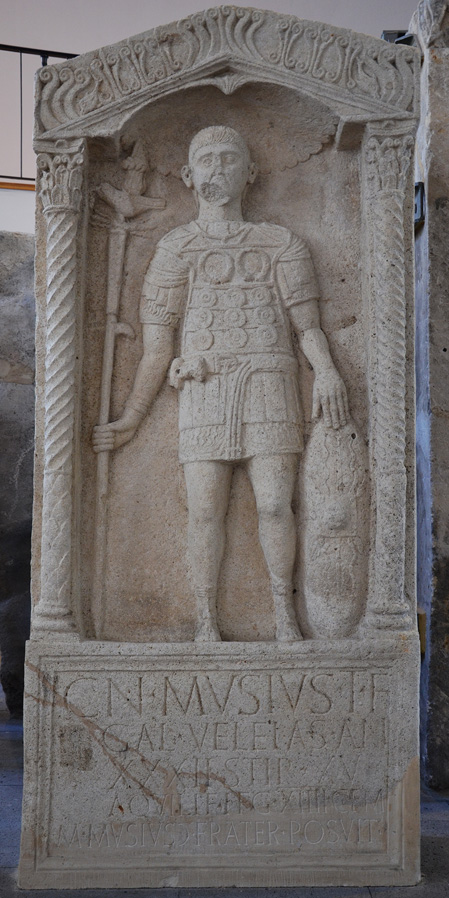
For one, the Facilis sculptor understood about ‘foreshortening’ an important concept for any artist if they wish to represent anything realistically.  He knows that if you depict the hand on the hilt of the sword, then the elbow of that arm will be thrust backwards, and will not be visible.  Another sculptor depicting a standard bearer, named Gnaeus Musius, can only show this by having the entire right arm visible, awkwardly holding the standard out at the soldier’s side.  

Again, the Facilis sculptor understands that when you stand facing someone and look down at the ground, you see the floor seemingly sloping away behind the person.  This gives his work a sense of three dimensions.  The sculptor of the Musius stone doesn’t understand this or thinks it unimportant, and depicts the ground as a single line under the soldier’s feet.

The Gnaeus Musius stele.  Wikipedia commons.
The Facilis sculptor understood the classical form, that a figure can be made to display grace and ease by the simple expedient of giving the torso a slight curve (what the artist Hogarth called the ‘line of beauty and grace’).   The weight of the subject held on the right leg pushes out the opposite hip, which in turn causes the torso to curve over to the right.  The sculptor finishes by either positioning the head centrally or by emphasising the curve still further by depicting it on a slight tilt.

The Musius sculptor is unable to depict the standard bearer in a realistic and convincing posture, he stands stiffly and completely upright as if he really were made of stone, the limbs clumsily realised and the only thing the sculptor is interested in doing is depicting the soldiers armour and decorations in close detail.

There is of course a school of thought that states that the Facilis stele is copied from a statue of the emperor Claudius.  If you study the slightly eroded head of Facilis' figure you see easily that it has quite large sticky out ears.  This was a feature of all portrait busts of Claudius because - well, he had sticky out ears.  So its possible that the sculptor knew a statue of the emperor (now lost) that he used as a model.

The Facilis grave stele is not one of the great sculptures of the world  but it probably is one of the finest military sculptures from the ancient Roman world and it’s odd that its sculptor will only ever be known by this one modest sized work.  I can only admire this man, possibly a soldier, or a freelance artisan who followed the legion, for his ability to gain such knowledge in such difficult circumstances and to use it to honour brave men.  

My Zazzle page.

My website.